Open-source AI workspace
TIA Studio
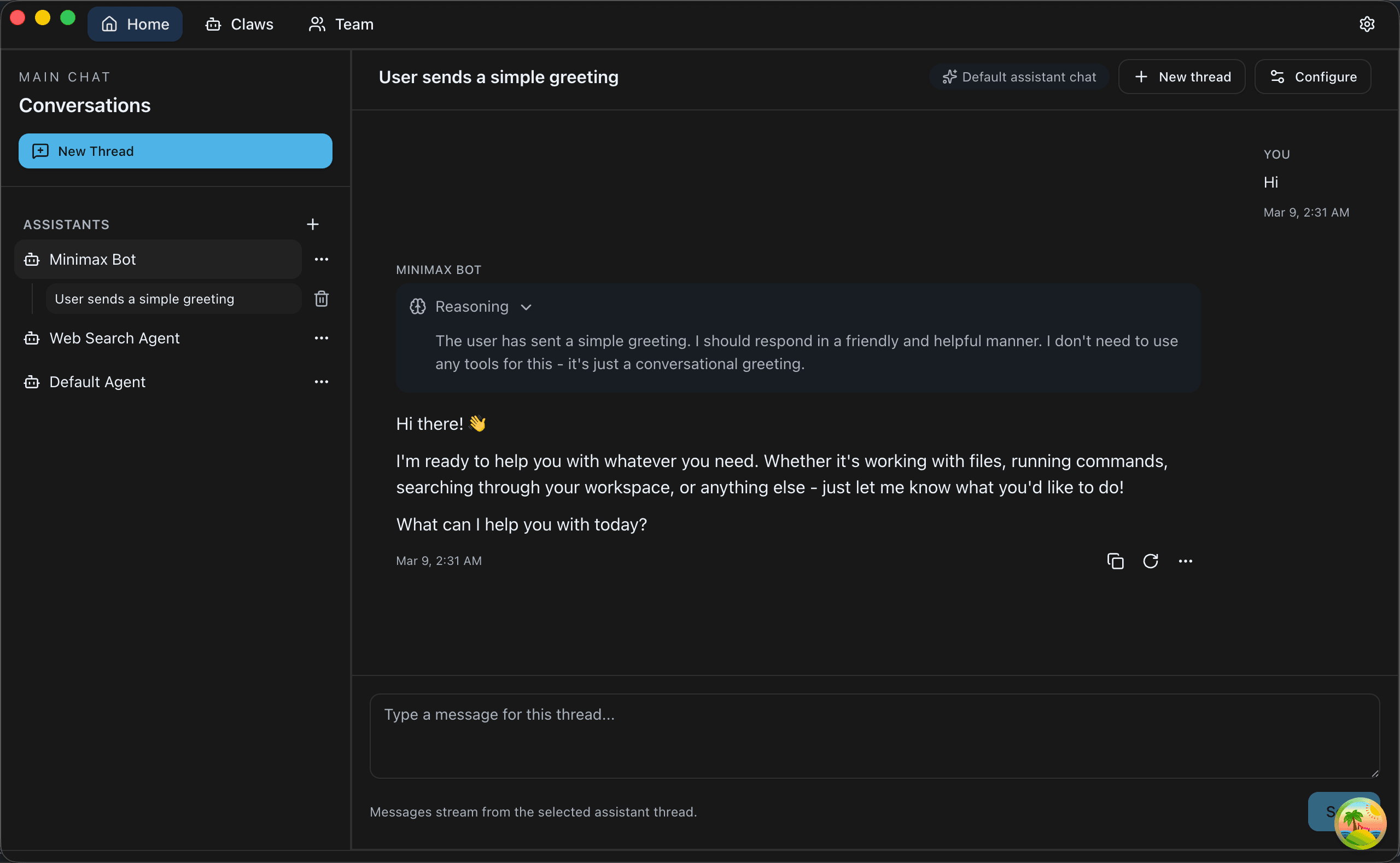
A desktop-native workspace for AI assistants, teams, channels, and local claws built for local-first operation.
Timeline
2026.03 - Present
Role
Open-source product engineering across desktop UX, assistant workflows, and channel-connected operations.
Outcome
Turned local assistant orchestration into a more usable desktop product by combining chat, team coordination, and channel operations in one workspace.
The product problem.
Developers needed a practical way to run assistants close to their tools, files, and real communication channels without depending on a cloud-hosted control plane.
The decision
Keep assistants as the core primitive and model claws as assistant-plus-channel pairings so identity, scheduling, and runtime behavior stay simpler to manage.
The hard part
Balancing a full assistant workspace with local-first channel automation required careful boundaries between desktop UX, channel transport, and assistant runtime state.
What I owned.
Open-source product engineering across desktop UX, assistant workflows, and channel-connected operations.
Built a desktop workspace for assistants, teams, threads, and channel-connected operations.
Shaped the claw workflow around assistant and channel composition instead of introducing a separate runtime entity.
Implemented a local-first product flow that supports channel integrations across Discord, Lark, Telegram, WhatsApp, Wecom, and Wechat-KF.
What changed.
Turned local assistant orchestration into a more usable desktop product by combining chat, team coordination, and channel operations in one workspace.
Made it faster to run local assistant operators from a native desktop workspace.
Unified assistant chat, team coordination, and channel automation in one open-source product.
Continue with
TIA
An on-device translation product built for lower-latency, cross-platform communication with a mobile-first user experience.